Key VPN statistics
- 23.8% of internet users ages 16 and older use a VPN for at least some of what they do online, according to GWI’s Q2 2026 survey of internet users in 53 countries.[1]
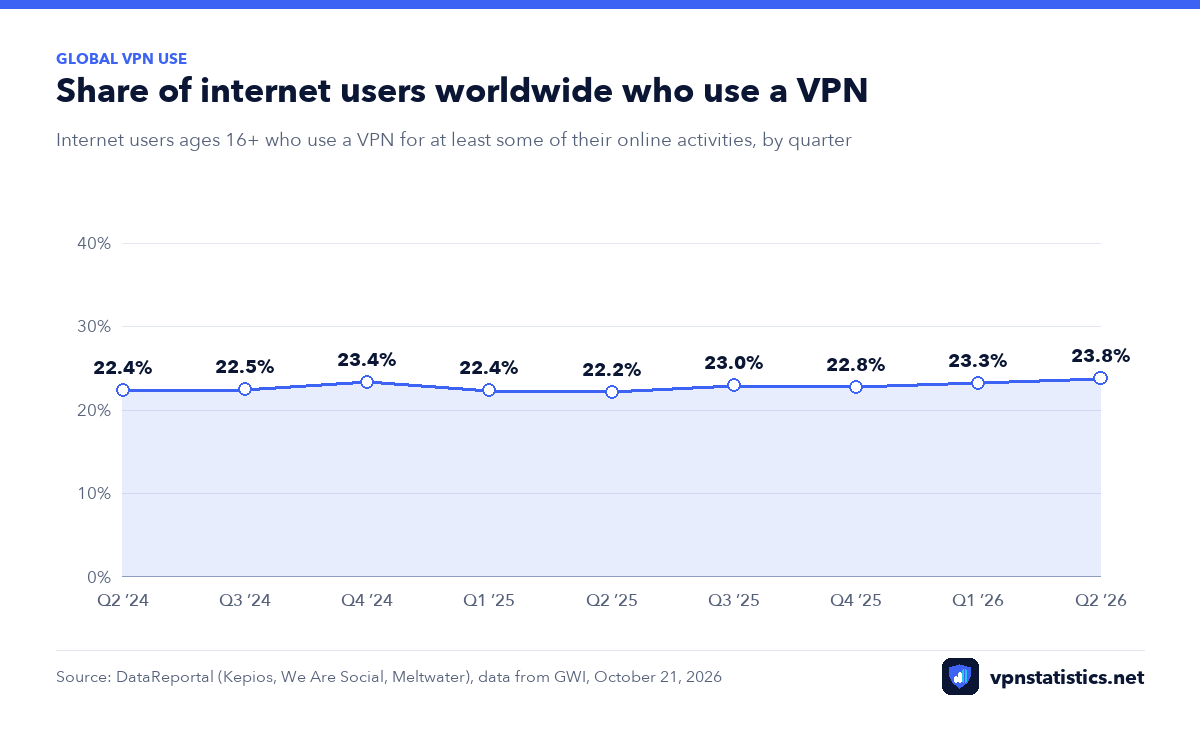
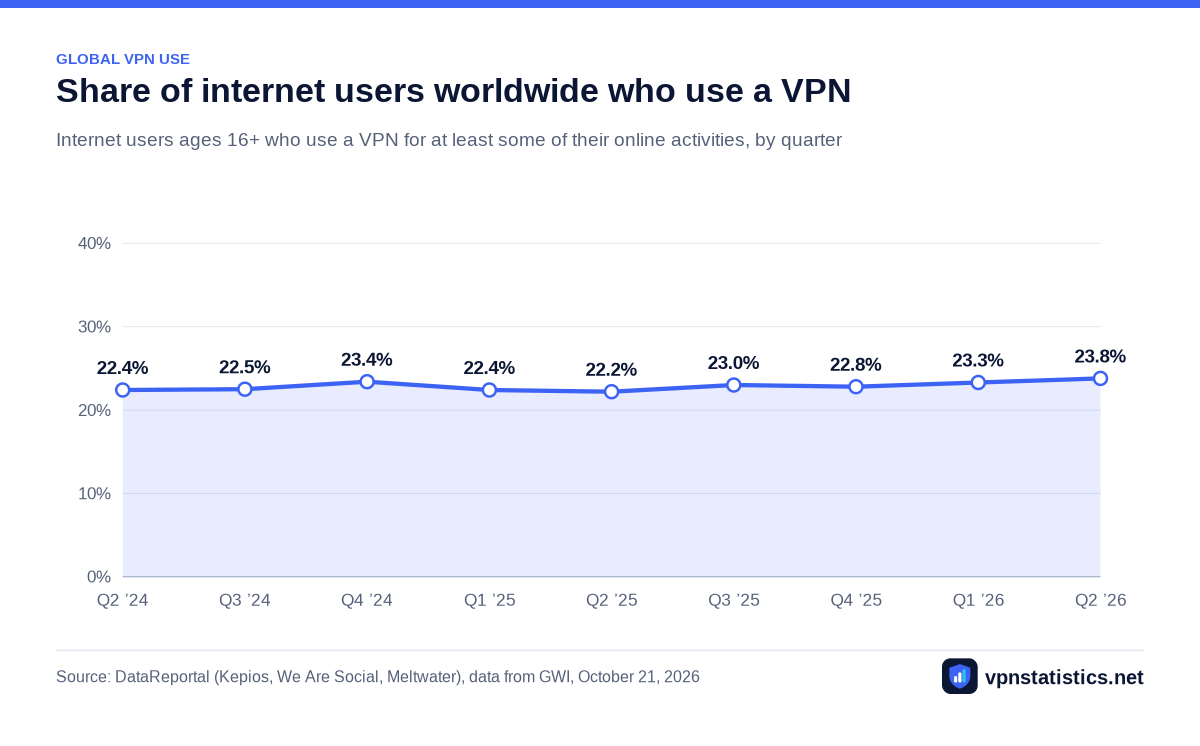
- That share has stayed between 22% and 24% since mid-2024.[1]
- No one counts VPN users directly. Applying GWI’s share to DataReportal’s October 2026 count of 6.15 billion internet users gives a rough estimate of about 1.46 billion. The often-quoted “1.75 billion” is a vendor estimate with no published method.[2][3]
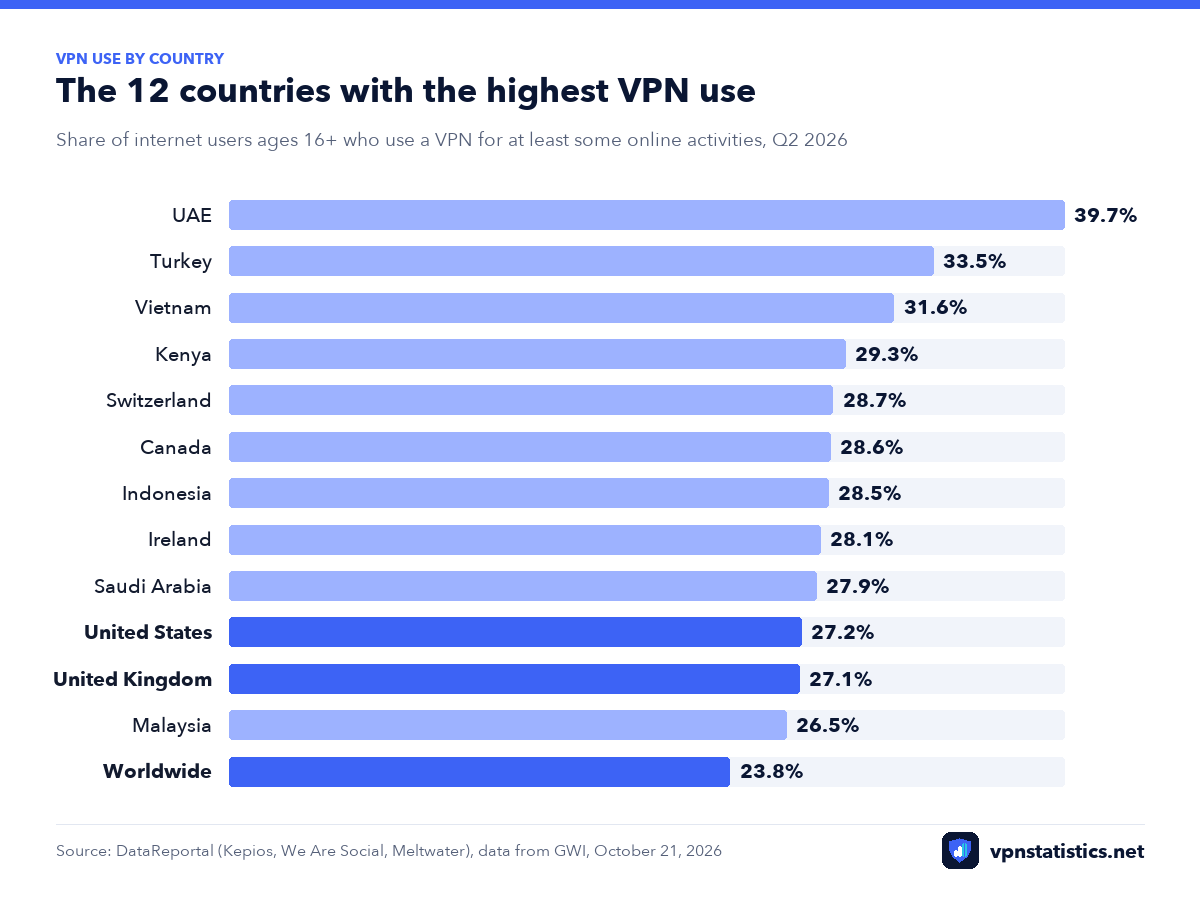
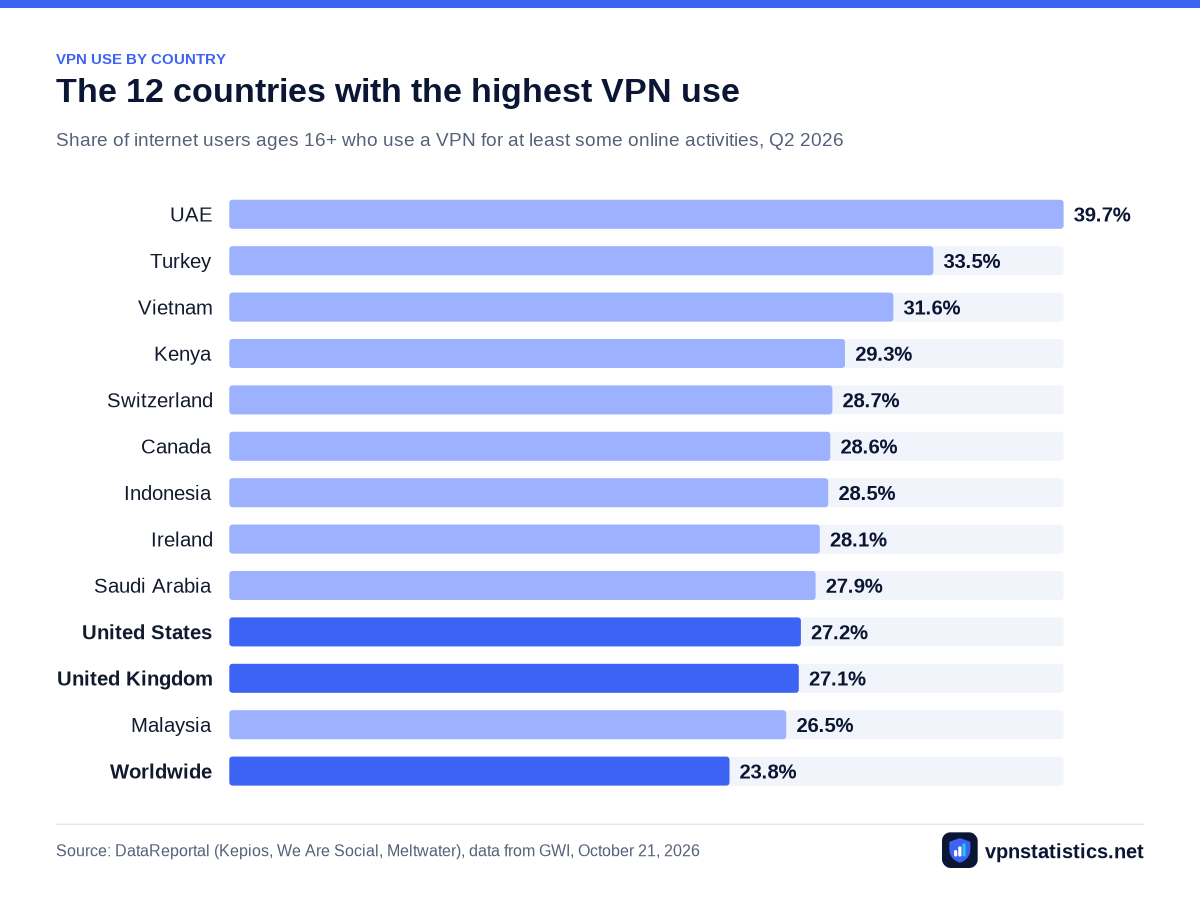
- Of the 53 countries in GWI’s Q2 2026 survey, the UAE has the highest rate of VPN use (39.7%), followed by Turkey (33.5%) and Vietnam (31.6%). Ghana has the lowest (7.3%), then Japan and Morocco (9.5% each).[1]
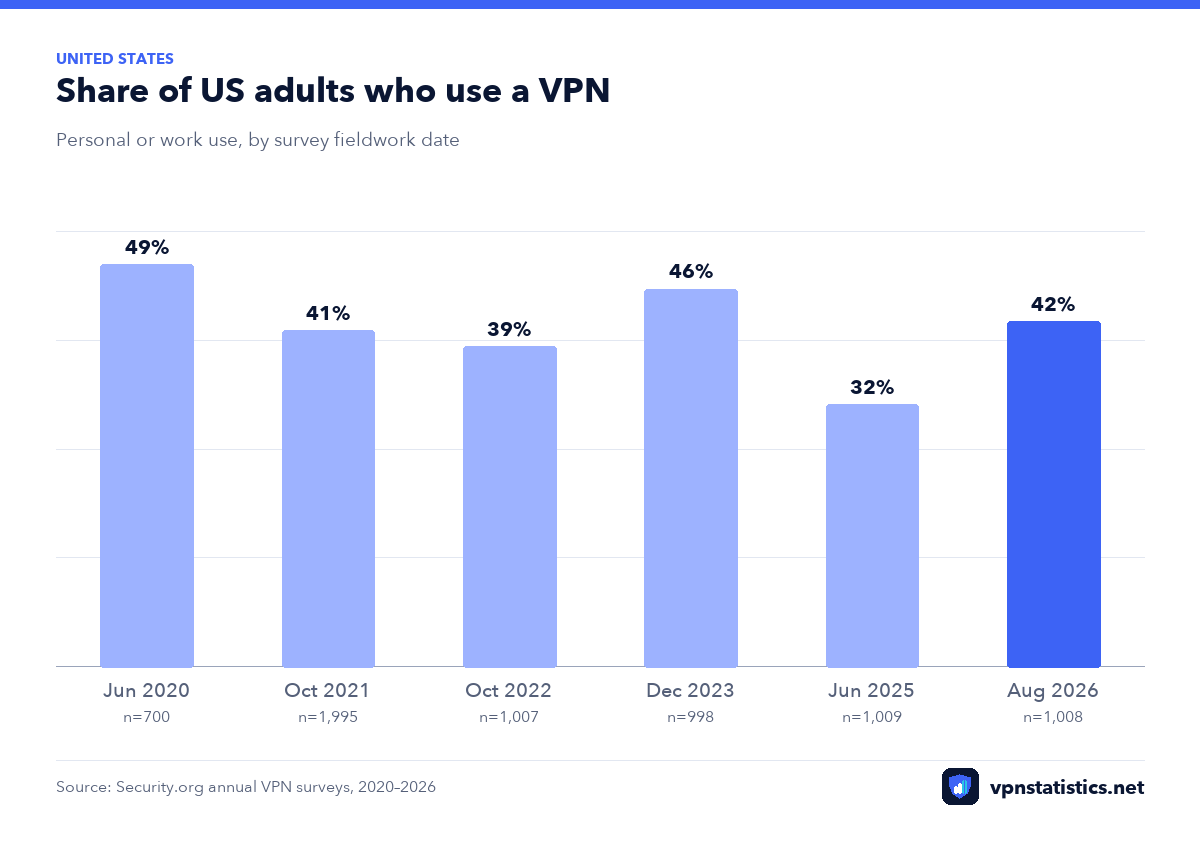
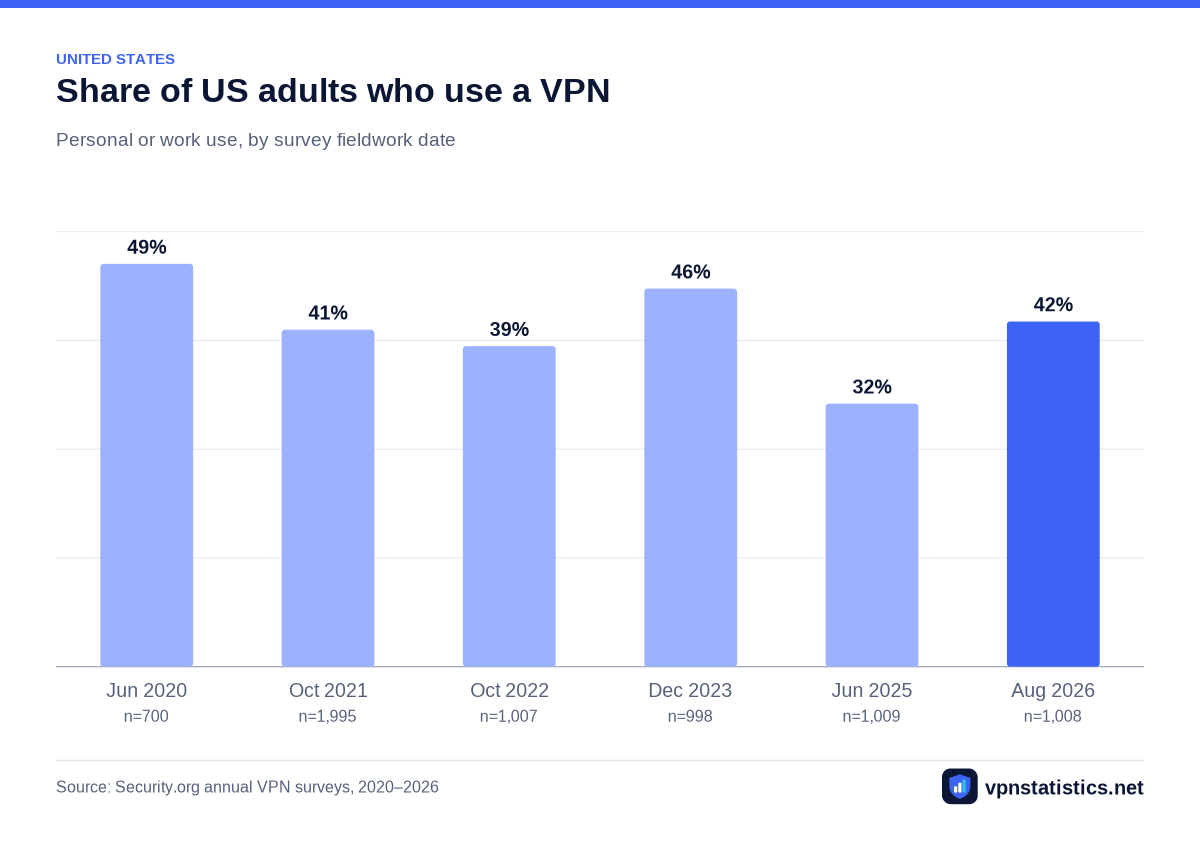
- 42% of US adults use a VPN for personal or work purposes, up from 32% in 2025 (Security.org survey of 1,008 adults, August 2026).[4]
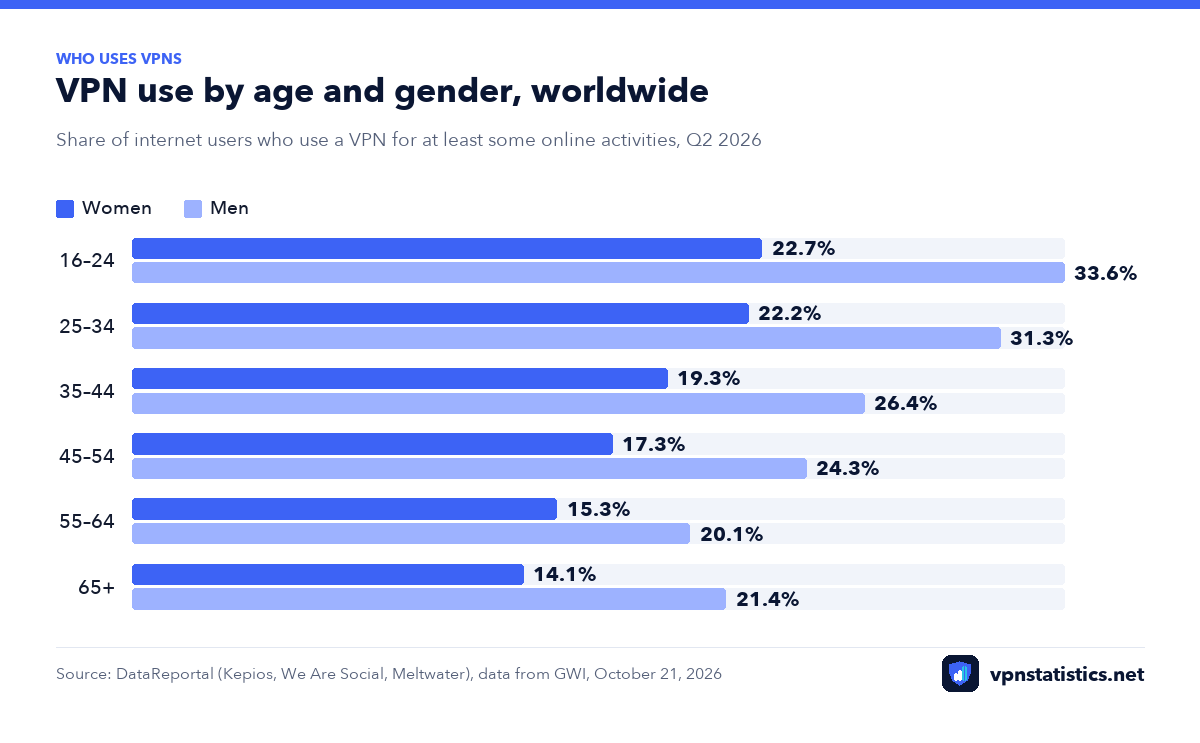
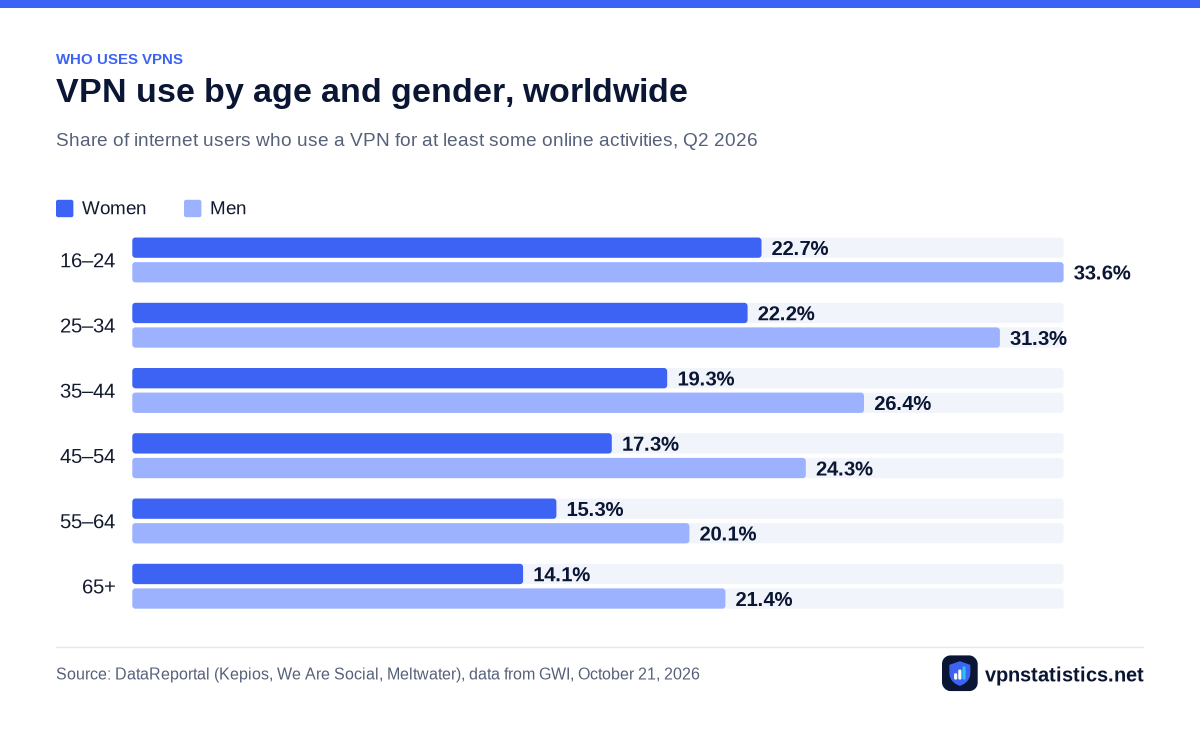
- Worldwide, men ages 16 to 24 are the most likely to use a VPN: 33.6% of male internet users in that age group use one, compared with 22.7% of women (GWI, Q2 2026).[1]
- 43% of US VPN users rely on a free service, and those who pay report spending $21 a month on average (Security.org, August 2026).[4]
- UK daily users of VPN apps more than doubled after age checks began in July 2025, from about 650,000 to over 1.4 million in mid-August, then fell to about 900,000 by November 2025, according to Ofcom.[5]
- Just under half (49.64%) of EU businesses with 10 or more employees used a VPN in 2024, according to Eurostat.[6]
- Six research firms value the 2025 global VPN market at between $54.1 billion and $89.0 billion; the gap reflects different definitions of the market.[7][8]
How many people use a VPN?#
The most consistent measure comes from GWI, a market research company that surveys internet users in 53 countries every quarter. In the second quarter of 2026, 23.8% of internet users ages 16 and older said they use a VPN for at least some of their online activities.[1]
Share of internet users worldwide who use a VPN
Internet users ages 16+ who use a VPN for at least some of their online activities, by quarter
Source: DataReportal (Kepios, We Are Social, Meltwater), data from GWI, October 21, 2026[1] · Russia excluded from every quarter so the series is comparable.
Show data table
| Quarter | Share of internet users |
|---|---|
| Q2 ’24 | 22.4% |
| Q3 ’24 | 22.5% |
| Q4 ’24 | 23.4% |
| Q1 ’25 | 22.4% |
| Q2 ’25 | 22.2% |
| Q3 ’25 | 23.0% |
| Q4 ’25 | 22.8% |
| Q1 ’26 | 23.3% |
| Q2 ’26 | 23.8% |
The line is almost flat: between mid-2024 and mid-2026 the share moved only between 22.2% and 23.8%. Claims that VPN use is “surging” usually refer to searches or downloads during a single event.
Rough estimate of VPN users worldwide: GWI’s 23.8% applied to 6.15 billion internet users. It could be too high (online panels lean toward well-connected users) or too low (high-use countries such as Russia and Iran are not surveyed, and under-16s are excluded).[1][2]
Why you see 1.46 billion, 1.75 billion and 150 million
Estimates of VPN users worldwide, and what each one measures
| Figure | Who says so | What it measures | Can you cite it? |
|---|---|---|---|
| ≈1.46 billion | Our calculation from GWI and DataReportal | Rough estimate: share of internet users 16+ × all internet users | Yes, as an estimate with the method |
| Over 1.75 billion | Surfshark (a VPN company) | Not explained beyond “countries where VPN market penetration is above 10%” | Only as “Surfshark estimates” |
| About 150 million | Business of Apps | VPN app users in 2025 (search snippets say about 147 million); definition and data provider not stated, and we could not open the page | Only with a note that the method is not published |
| 31% of internet users | GWI with Top10VPN (2020) | Internet users 16–64 who used a VPN in the past month, Q4 2019 | Only as a 2019 figure |
Sources: DataReportal/GWI; Surfshark; Business of Apps; Top10VPN and GlobalWebIndex 2020.[3][9][10]
VPN usage by country#
The United Arab Emirates has the highest share of internet users on a VPN: 39.7%. Turkey (33.5%) and Vietnam (31.6%) come next. The United States (27.2%) and the United Kingdom (27.1%) sit just above the global figure.[1]
The 12 countries with the highest VPN use
Share of internet users ages 16+ who use a VPN for at least some online activities, Q2 2026
Source: DataReportal (Kepios, We Are Social, Meltwater), data from GWI, October 21, 2026[1]
Show data table
| Country | Share of internet users |
|---|---|
| UAE | 39.7% |
| Turkey | 33.5% |
| Vietnam | 31.6% |
| Kenya | 29.3% |
| Switzerland | 28.7% |
| Canada | 28.6% |
| Indonesia | 28.5% |
| Ireland | 28.1% |
| Saudi Arabia | 27.9% |
| United States | 27.2% |
| United Kingdom | 27.1% |
| Malaysia | 26.5% |
| Worldwide | 23.8% |
At the other end, only 7.3% of internet users in Ghana and 9.5% in Japan and Morocco use a VPN. Russia was the highest of all at 50.3% in Q2 2025, but GWI stopped surveying Russia in 2026, so there is no current figure.[11]
How many Americans use a VPN?#
42% of US adults use a VPN for personal or work purposes, according to Security.org’s August 2026 survey of 1,008 adults. That is up from 32% in its June 2025 survey.[4][13]
of US adults use a VPN for personal or work purposes, up from 32% in 2025.[4]
of US adults ages 18 to 29 use a VPN, the highest of any age group.[4]
of US adults use a VPN only for personal reasons, up 8 points in a year.[4]
of US internet users ages 16+ use a VPN for at least some online activities (GWI’s narrower question).[1]
Share of US adults who use a VPN
Personal or work use, by survey fieldwork date
Source: Security.org annual VPN surveys, 2020–2026[4][13][14][15][16] · 700 to 1,995 adults per wave; sample size, weighting and question wording changed between waves.
Show data table
| Fieldwork | US adults using a VPN |
|---|---|
| Jun 2020 (n=700) | 49% |
| Oct 2021 (n=1,995) | 41% |
| Oct 2022 (n=1,007) | 39% |
| Dec 2023 (n=998) | 46% |
| Jun 2025 (n=1,009) | 32% |
| Aug 2026 (n=1,008) | 42% |
Read the US trend with care
Recent waves asked about 1,000 people, so the margin of error is roughly ±3 points. A 14-point drop followed by a 10-point rise is more than that, and sample size, weighting and question wording changed between waves; the 2026 panel was not weighted. The survey platform also blocks VPN users, which Security.org says may lead to under-counting.[4] The latest wave, quoted with its date, is a safer figure to cite than a multi-year trend.
GWI’s figure for the US is lower, at 27.2%. It asks a narrower question, of a different sample: internet users ages 16 and older.[1] Either can be cited, as long as the sentence matches the question each survey asked. More US data: age, gender, reasons and brands →
Who uses VPNs: age and gender#
Men are more likely than women to use a VPN in every age group, and use generally falls with age (GWI notes that its 65+ figures are not directly comparable). The gap is widest among 16- to 24-year-olds: 33.6% of men and 22.7% of women.[1]
VPN use by age and gender, worldwide
Share of internet users who use a VPN for at least some online activities, Q2 2026
Source: DataReportal (Kepios, We Are Social, Meltwater), data from GWI, October 21, 2026[1] · 65+ data is not yet available in every country.
Show data table
| Age group | Women | Men |
|---|---|---|
| 16–24 | 22.7% | 33.6% |
| 25–34 | 22.2% | 31.3% |
| 35–44 | 19.3% | 26.4% |
| 45–54 | 17.3% | 24.3% |
| 55–64 | 15.3% | 20.1% |
| 65+ | 14.1% | 21.4% |
The US data shows the same pattern. Half of men (50%) and four in ten women (40%) use a VPN, and 51% of adults ages 18 to 29 do.[4]
Why people use VPNs (US data)#
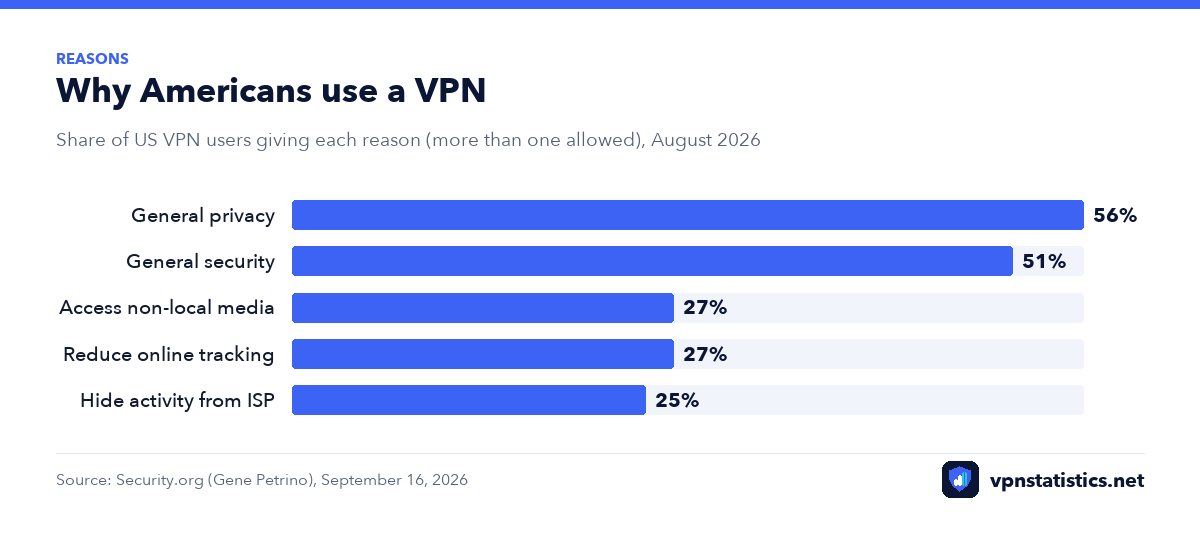
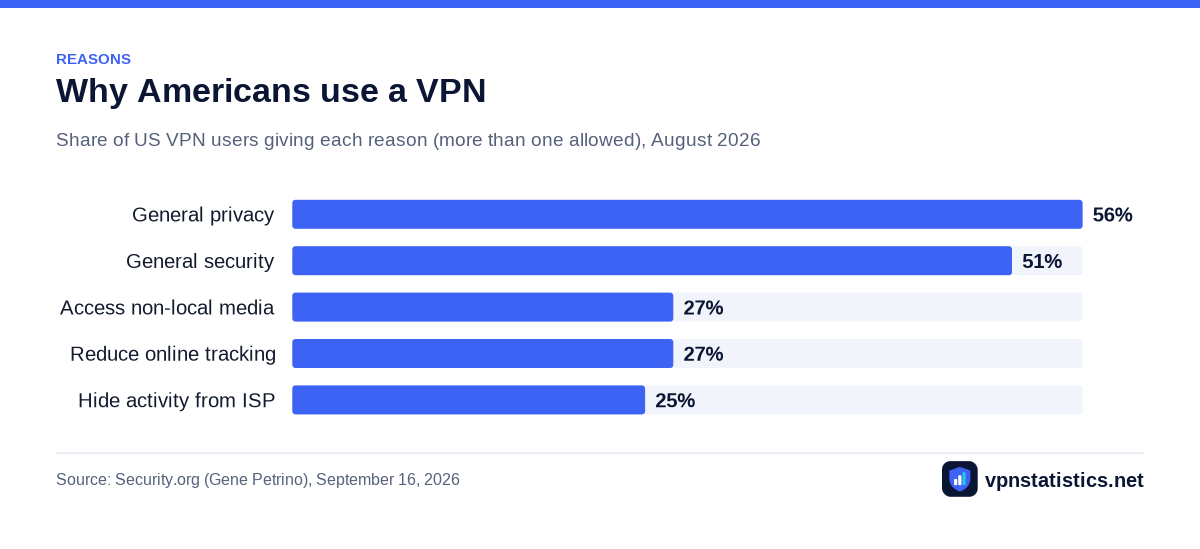
Among US VPN users, 56% cite general privacy and 51% general security as reasons (Security.org, August 2026). Watching media from other countries and cutting down on tracking tie for third at 27%.[4]
Why Americans use a VPN
Share of US VPN users giving each reason (more than one allowed), August 2026
Show data table
| Reason | Share of VPN users |
|---|---|
| General privacy | 56% |
| General security | 51% |
| Access non-local media | 27% |
| Reduce online tracking | 27% |
| Hide activity from ISP | 25% |
More than one in ten US VPN users rely on one for age-restricted or adult content.[4] Among people who don’t use a VPN, the most common reason is that they don’t think they need one (39%).[4] And 36% of Americans wrongly believe a VPN on its own protects a device from viruses and malware.[4]
Free vs paid VPNs#
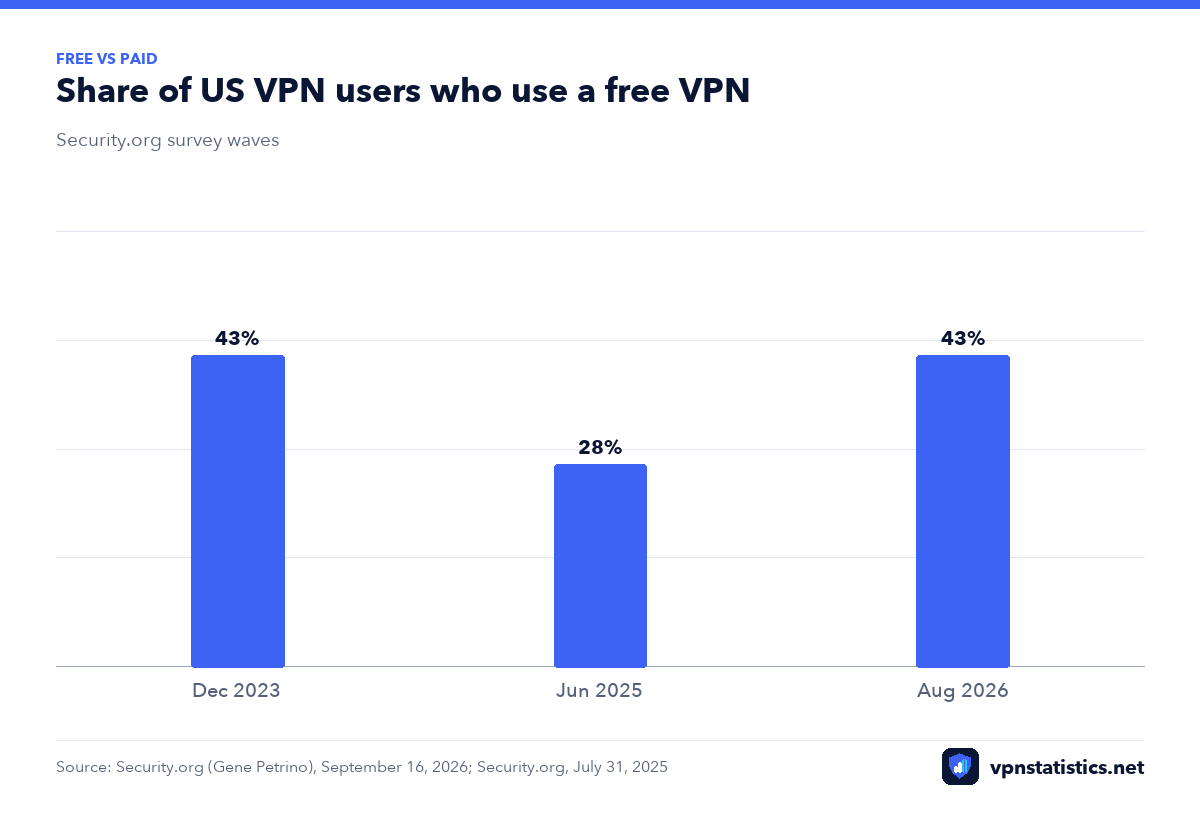
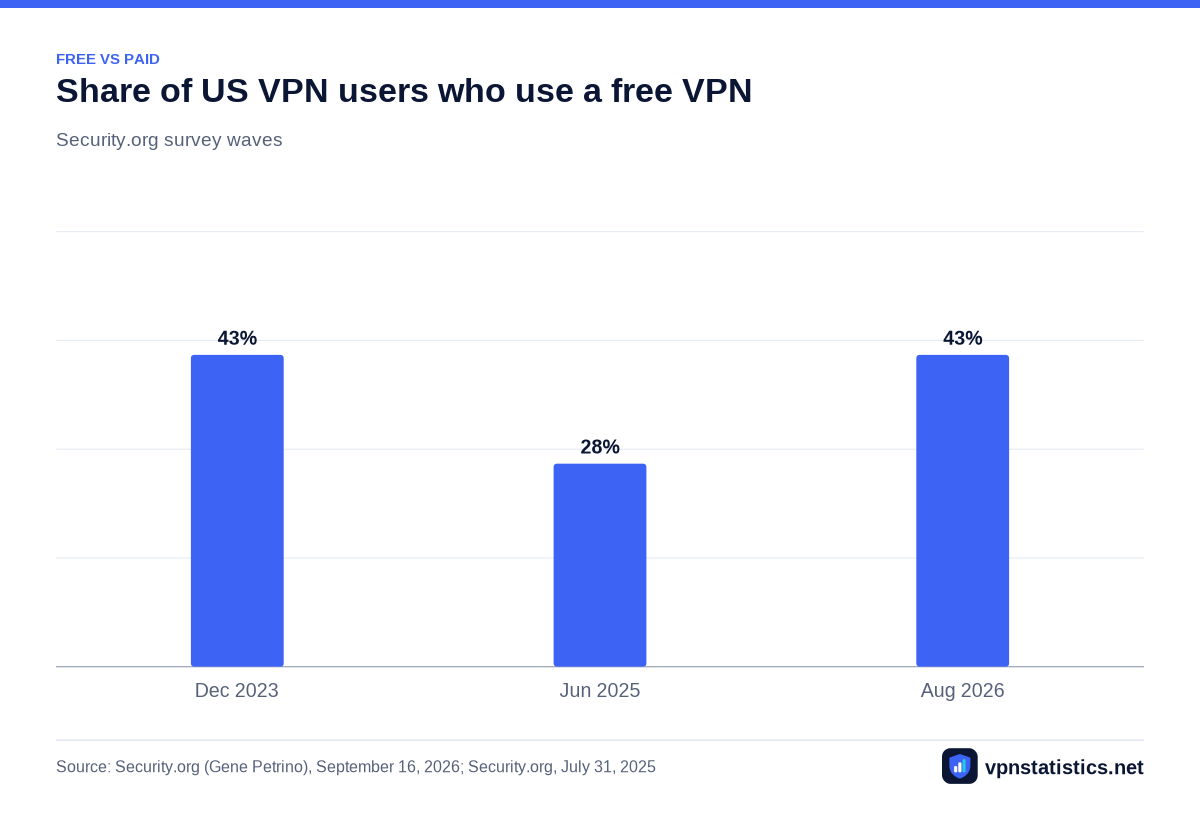
43% of US VPN users rely on a free VPN, up from 28% a year earlier. Paying users report spending $21 a month on average.[4]
Share of US VPN users who use a free VPN
Security.org survey waves
Show data table
| Fieldwork | Share using a free VPN |
|---|---|
| Dec 2023 | 43% |
| Jun 2025 | 28% |
| Aug 2026 | 43% |
The $21 figure is a self-reported average, and a few large bundles can pull it up. Security.org’s 2025 report gave a median of $10 a month, a different measure that can’t be compared with it.[13]
popular Android VPN apps tested by university researchers sent some data unencrypted; 29 leaked traffic outside the tunnel.[17]
top free VPN apps on Apple’s US App Store were owned by companies in mainland China or Hong Kong without clearly saying so.[18]
Most-used VPN brands in the US#
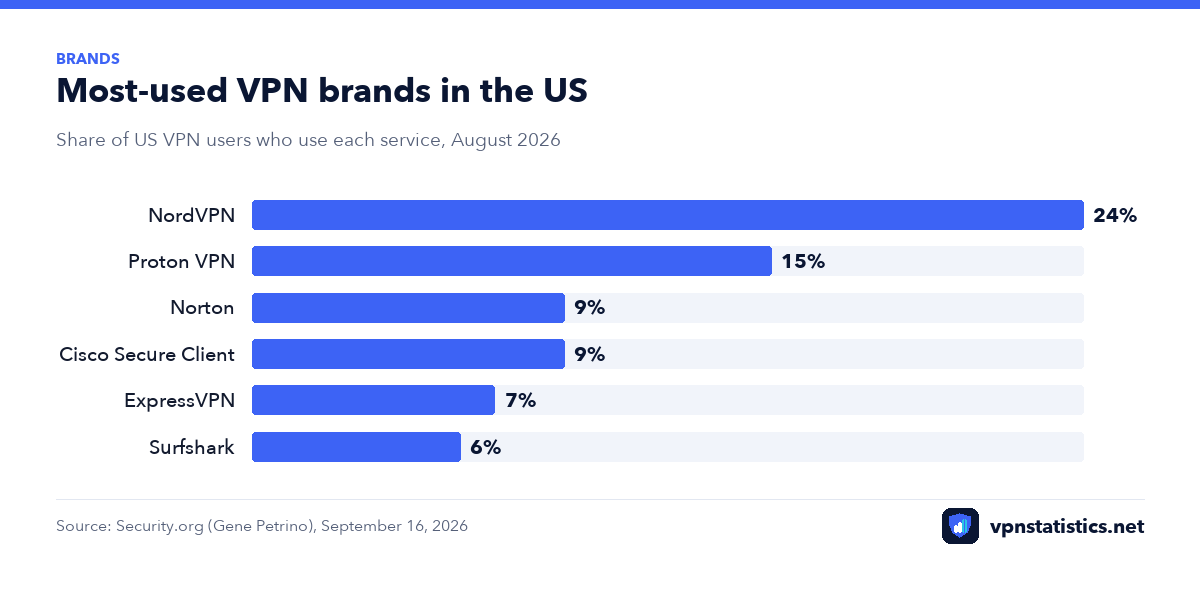
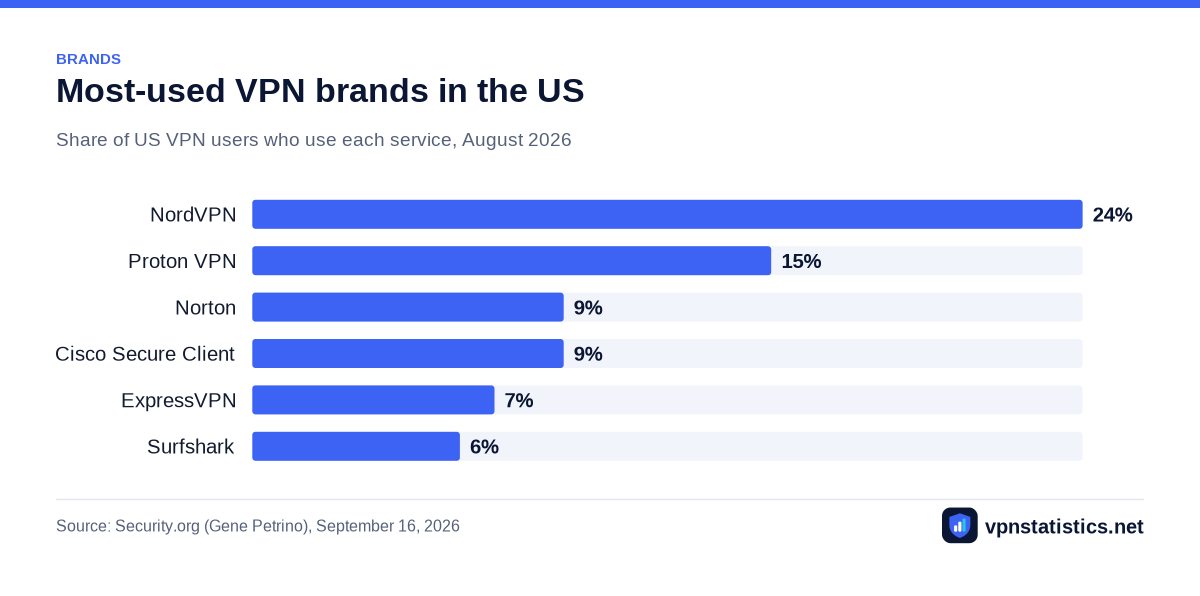
In the US, NordVPN is the most-used VPN (24% of users), ahead of Proton VPN (15%). Norton and Cisco Secure Client follow at 9% each. Cisco’s app is mostly a workplace VPN.[4]
Most-used VPN brands in the US
Share of US VPN users who use each service, August 2026
Show data table
| VPN | Share of VPN users |
|---|---|
| NordVPN | 24% |
| Proton VPN | 15% |
| Norton | 9% |
| Cisco Secure Client | 9% |
| ExpressVPN | 7% |
| Surfshark | 6% |
Security.org earns affiliate commission from some of these brands.[19] We report its brand data because we found no other recent survey that publishes it.
Many brands share owners. ExpressVPN, CyberGhost and Private Internet Access belong to Kape Technologies, and NordVPN and Surfshark merged in 2022.[20][21][22] Who owns which VPN →
VPN use in the UK after the Online Safety Act#
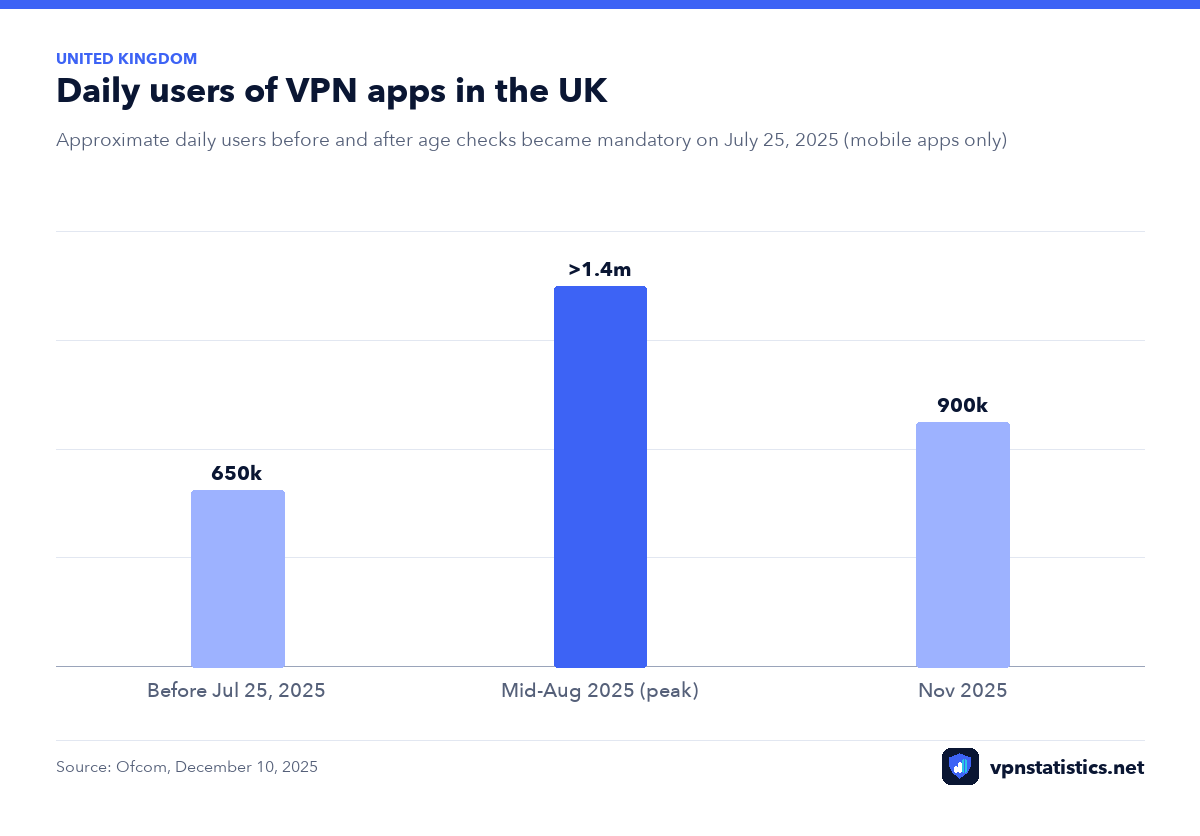
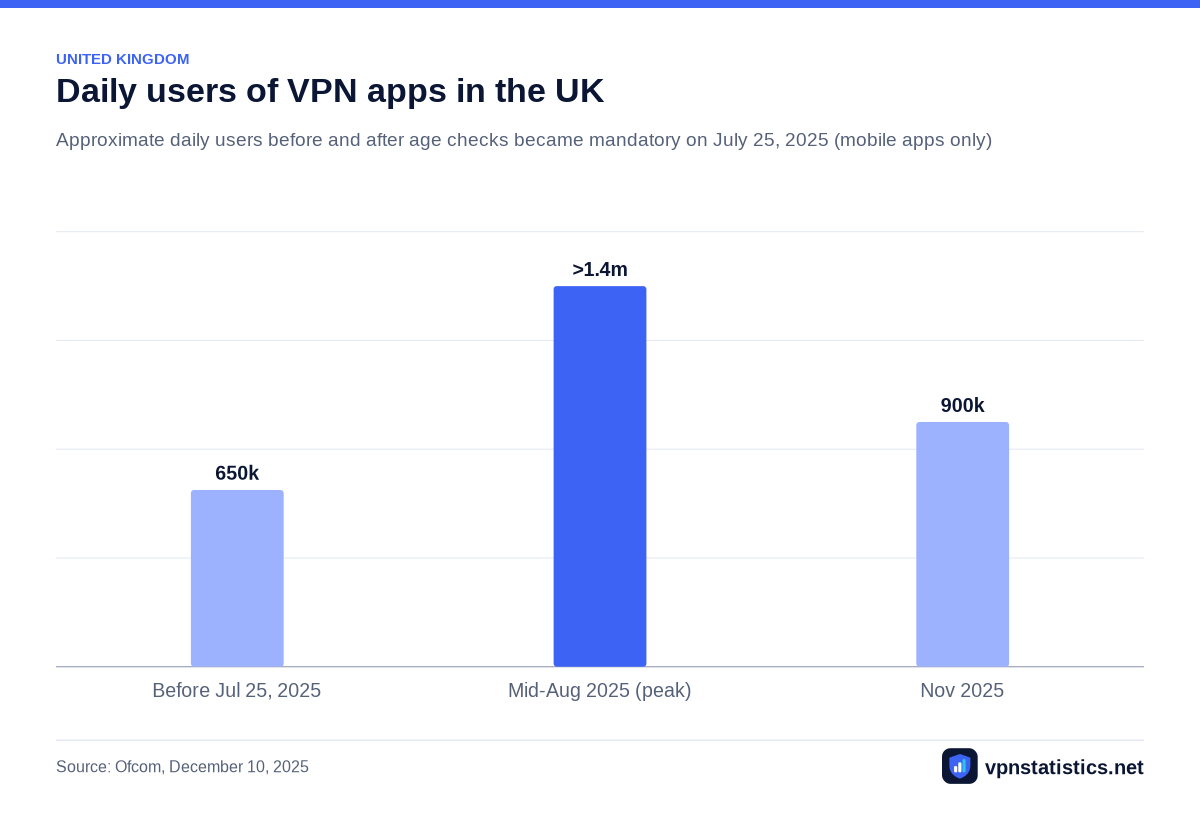
When UK age checks for adult content became mandatory on July 25, 2025, daily users of VPN apps more than doubled, from about 650,000 to a peak of over 1.4 million in mid-August. By November 2025 the figure had fallen to about 900,000.[5]
Daily users of VPN apps in the UK
Approximate daily users before and after age checks became mandatory on July 25, 2025 (mobile apps only)
Show data table
| Period | Daily VPN app users |
|---|---|
| Before Jul 25, 2025 | 650k |
| Mid-Aug 2025 (peak) | >1.4m |
| Nov 2025 | 900k |
UK daily users of VPN apps at the mid-August 2025 peak, from about 650,000 before age checks began (mobile apps only).[5]
of UK children ages 11 to 17 have ever used a VPN; 22% have in the last three months.[23]
Ofcom’s figures come from the app analytics firm Apptopia and count mobile apps only, so desktop VPN users are missing.[5][24] A government research report notes that “it was not clear whether this spike was driven by children or adults seeking to avoid age checks.”[23] In July 2026 the UK government said: “We will not ban or age-gate VPNs.”[25] Full UK VPN data →
What makes VPN demand spike#
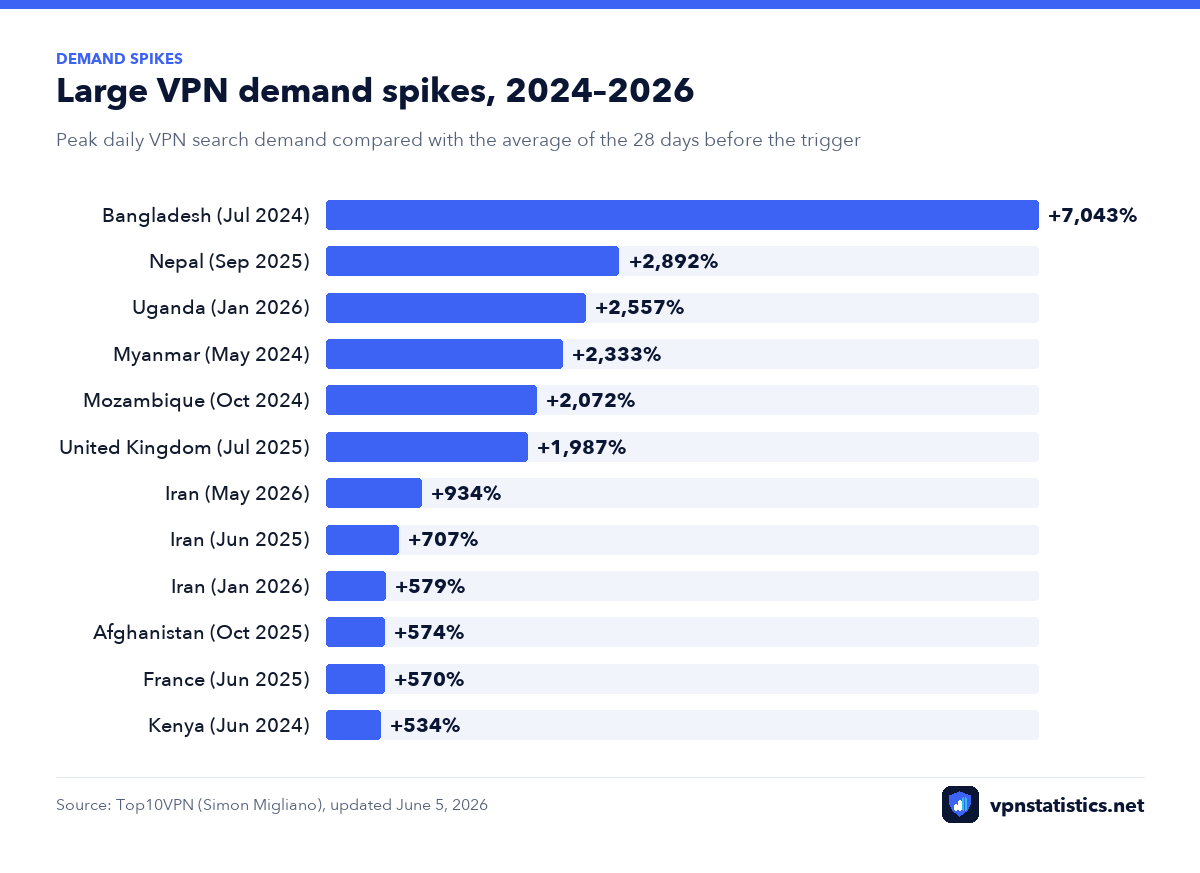
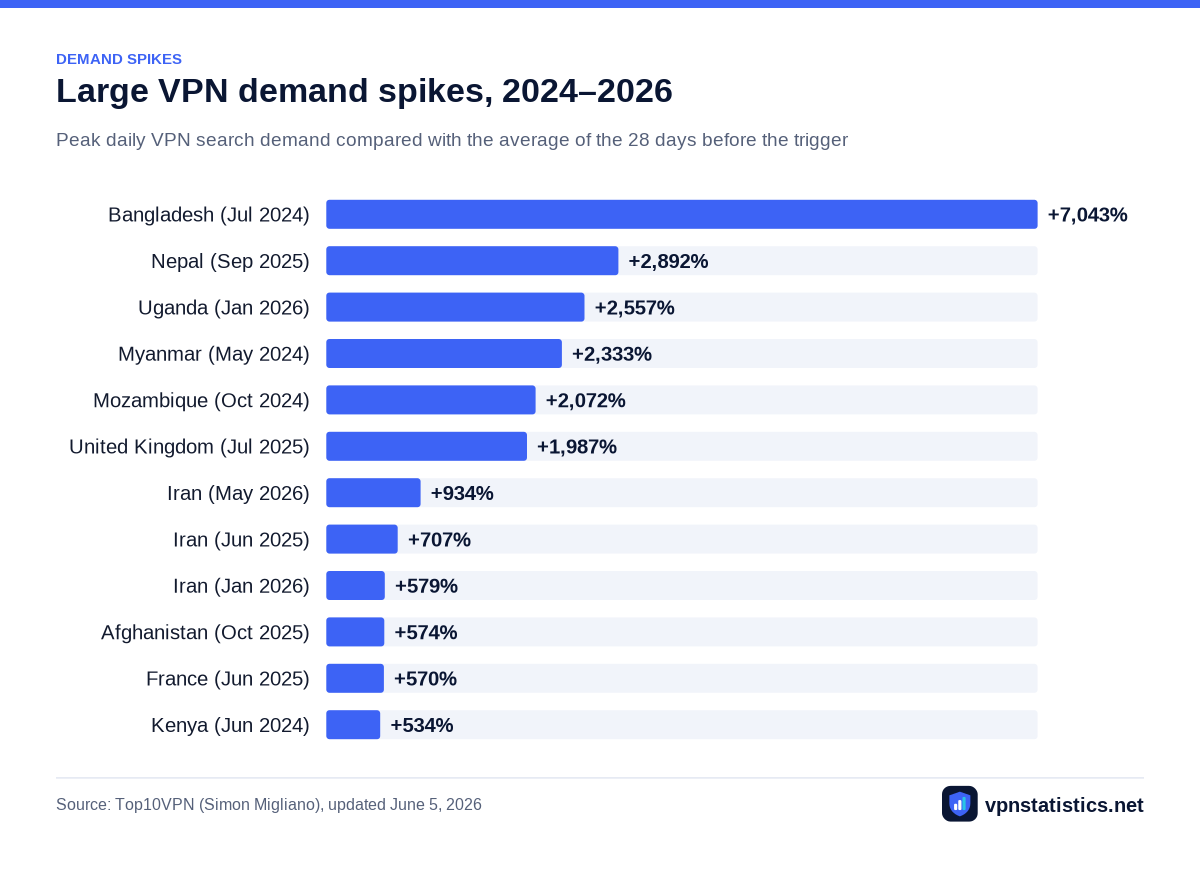
The biggest jumps in VPN searches have followed internet shutdowns and social media blackouts. During a social media blackout before its November 2024 election, VPN searches in Mauritius rose 24,001% above normal; in Bangladesh they rose 7,043% when access returned after a shutdown in July 2024. Age-verification rules have brought smaller but more frequent spikes: +1,987% in the UK in July 2025 and +570% in France in June 2025.[26]
Large VPN demand spikes, 2024–2026
Peak daily VPN search demand compared with the average of the 28 days before the trigger
Source: Top10VPN (Simon Migliano), updated June 5, 2026[26] · Mauritius (+24,001%, Nov 2024) is left off so the other bars stay readable. A 2,000% rise in searches (21 times the usual level) does not mean 21 times as many VPN users.
Show data table
| Country (month) | Peak increase in VPN searches |
|---|---|
| Bangladesh (Jul 2024) | +7,043% |
| Nepal (Sep 2025) | +2,892% |
| Uganda (Jan 2026) | +2,557% |
| Myanmar (May 2024) | +2,333% |
| Mozambique (Oct 2024) | +2,072% |
| United Kingdom (Jul 2025) | +1,987% |
| Iran (May 2026) | +934% |
| Iran (Jun 2025) | +707% |
| Iran (Jan 2026) | +579% |
| Afghanistan (Oct 2025) | +574% |
These are search figures from Top10VPN’s demand tracker. They measure interest rather than use: in the UK, searches rose about 21-fold while daily app users roughly doubled.[26][5] VPN demand spikes since 2024, country by country →
VPN market size and revenue#
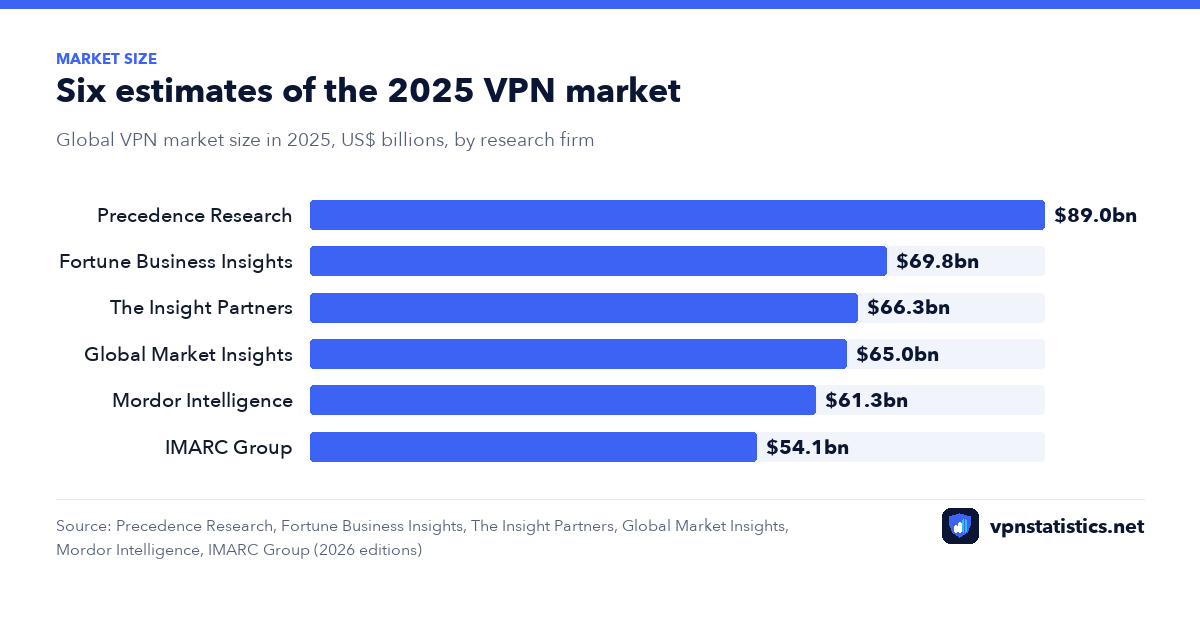
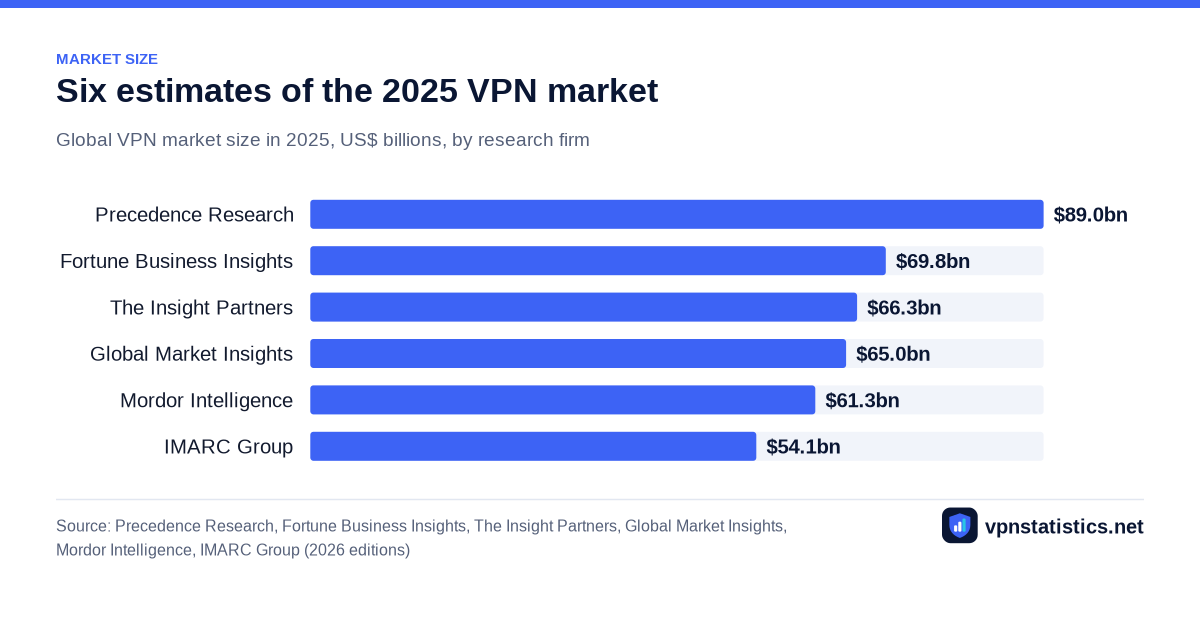
Six research firms that published in 2026 value the 2025 global VPN market at between $54.1 billion (IMARC) and $89.0 billion (Precedence Research). The median of the six estimates is about $65.7 billion (our calculation).[7][8]
Six estimates of the 2025 VPN market
Global VPN market size in 2025, US$ billions, by research firm
Source: Precedence Research, Fortune Business Insights, The Insight Partners, Global Market Insights, Mordor Intelligence, IMARC Group (2026 editions)[8][27][28][29][30][7]
Show data table
| Research firm | 2025 market size (US$ bn) |
|---|---|
| Precedence Research | $89.0bn |
| Fortune Business Insights | $69.8bn |
| The Insight Partners | $66.3bn |
| Global Market Insights | $65.0bn |
| Mordor Intelligence | $61.3bn |
| IMARC Group | $54.1bn |
The gap is large because firms define the market differently: some count only consumer apps, others add corporate remote access, site-to-site networks and hardware. The four firms that forecast to 2034 put the market at $155.9 billion to $534.2 billion by then.[7][8] For the consumer side, Business of Apps reports that VPN apps made $5.9 billion in 2024, up 15.6%. It does not say where the data comes from, and we could not open the report to check it.[9]
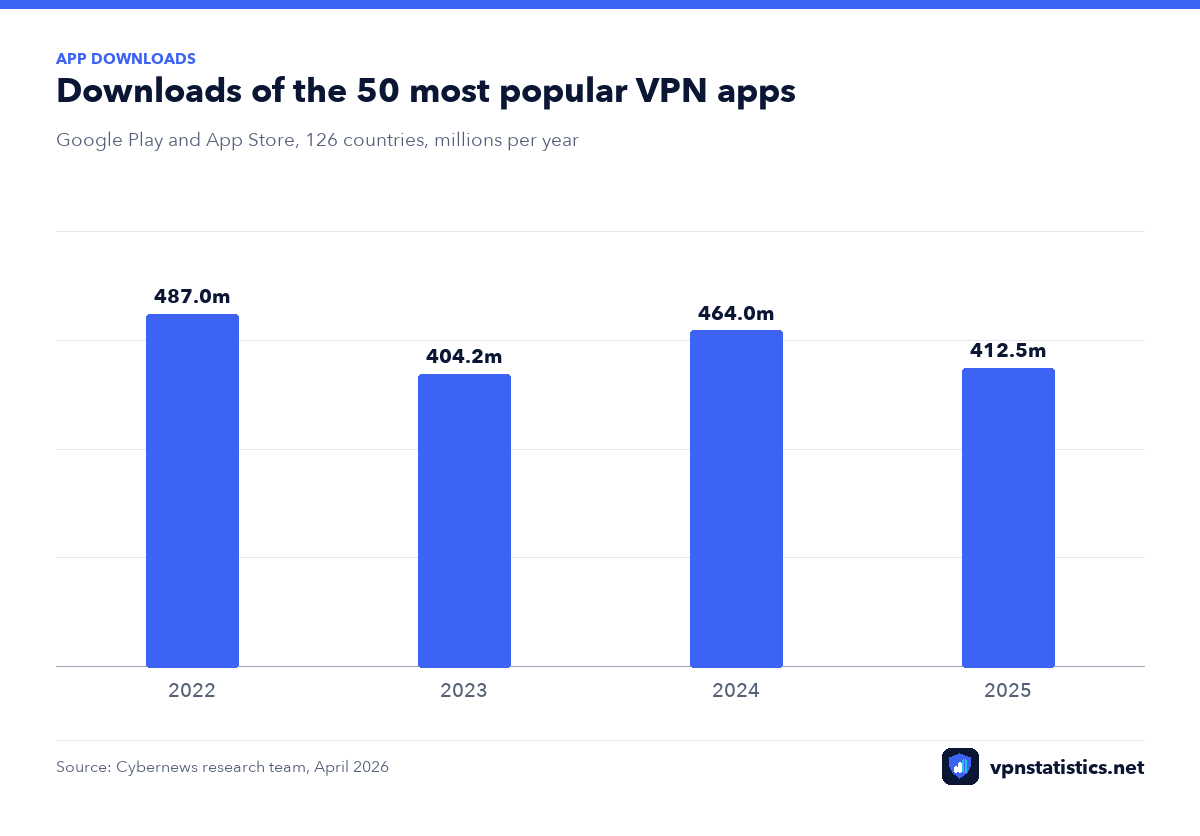
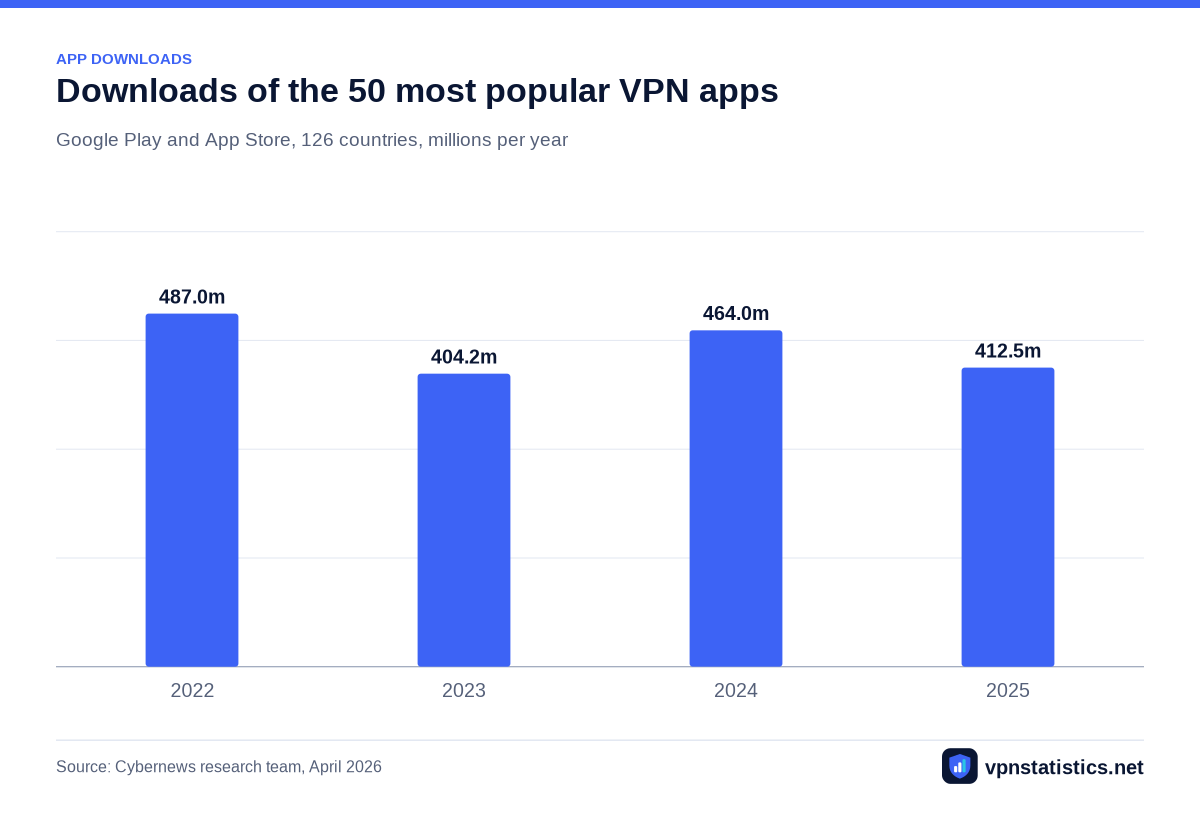
Downloads of the 50 most popular VPN apps
Google Play and App Store, 126 countries, millions per year
Source: Cybernews research team, April 2026[31] · Downloads count reinstalls and exclude desktop installs, so they are not user numbers.
Show data table
| Year | Downloads (millions) |
|---|---|
| 2022 | 487.0m |
| 2023 | 404.2m |
| 2024 | 464.0m |
| 2025 | 412.5m |
Every market estimate, with forecast years and growth rates →
VPNs at work#
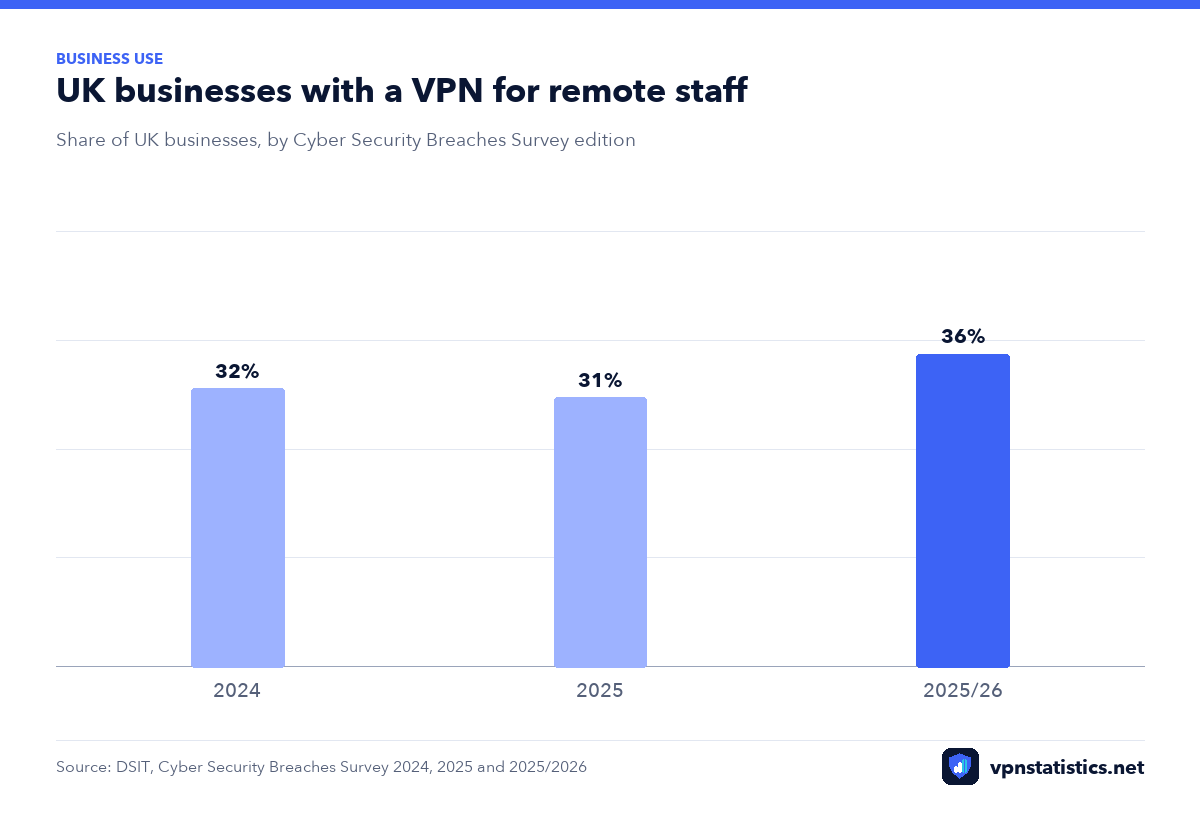
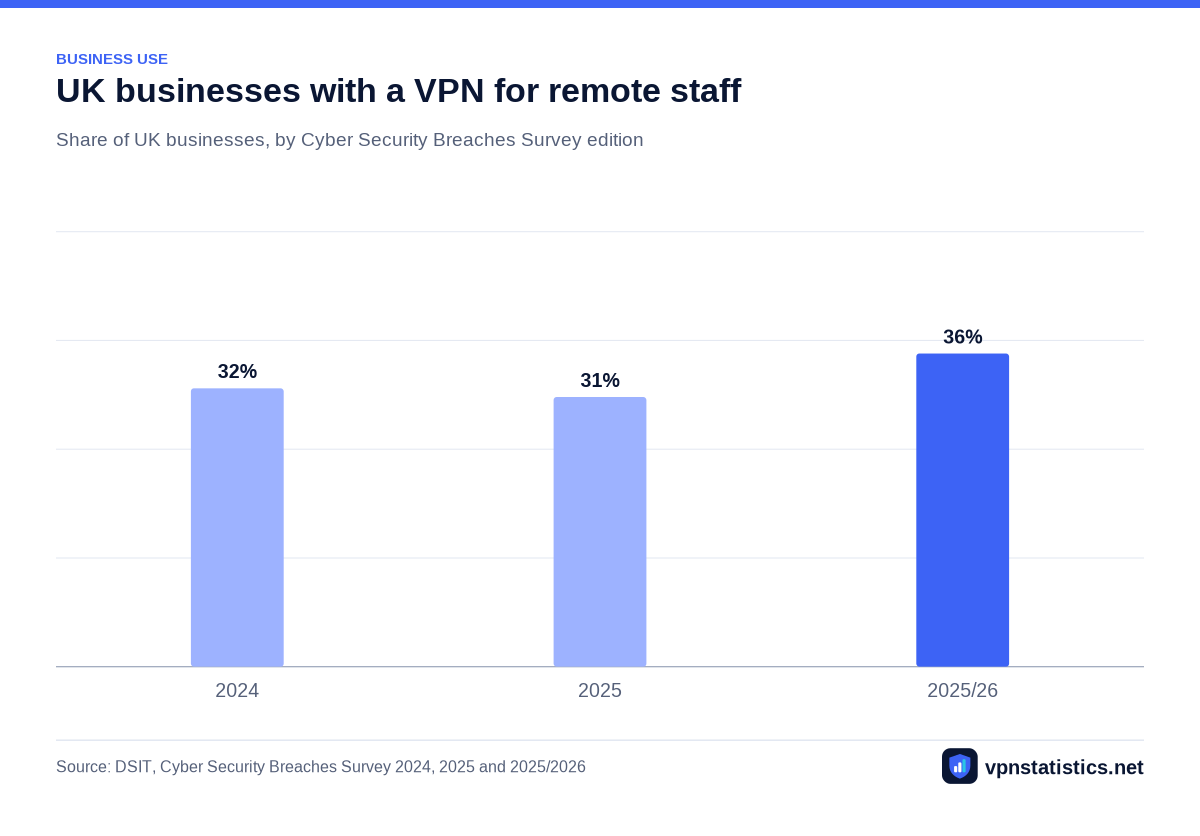
Just under half (49.64%) of EU businesses with at least 10 employees used a VPN in 2024, according to Eurostat.[6] In the UK, 36% of businesses had a VPN for staff connecting remotely in the 2025/26 survey, up from 31% a year earlier.[32]
UK businesses with a VPN for remote staff
Share of UK businesses, by Cyber Security Breaches Survey edition
Show data table
| Survey edition | Share of businesses |
|---|---|
| 2024 | 32% |
| 2025 | 31% |
| 2025/26 | 36% |
A vendor survey suggests some companies plan to move away from VPNs. In a 2025 survey by Zscaler, which sells VPN alternatives, 65% of organizations said they planned to replace their VPN within a year.[35]
VPN security statistics#
In Verizon’s 2025 Data Breach Investigations Report (DBIR), edge devices (internet-facing equipment such as firewalls and VPN gateways) and VPNs made up 22% of the targets of vulnerability exploitation, up almost eightfold from 3% the year before.[36]
of the targets of vulnerability exploitation were edge devices and VPNs, up from 3% a year earlier (Verizon).[36]
of those edge and VPN vulnerabilities were fully fixed during the year; the median time to fix was 32 days.[36]
That 22% is a share of exploitation cases, not of all breaches. US federal agencies were twice ordered to act on VPN flaws: the Cybersecurity and Infrastructure Security Agency (CISA) told them to disconnect Ivanti Connect Secure devices in early 2024 and to check Cisco ASA firewalls in September 2025.[37][38] More VPN security and enterprise data →
Where VPNs are banned or restricted#
VPNs are legal in most countries. A smaller group restricts them, some heavily: China allows only government-approved VPNs, Russia blocks hundreds of VPN services, and Iran has banned VPN use without a permit.[39][40][41]
Russia’s regulator said it had blocked 469 VPN services by the end of February 2026, up from 197 in October 2024.[40][42] Freedom House says authorities in 21 of the 72 countries it monitors have tried to block VPNs or other circumvention tools in the past five years.[43]
VPNs are not illegal in the UAE
The UAE punishes using a VPN or a false IP address to commit a crime or avoid detection, with temporary imprisonment and/or a fine of AED 500,000 to 2 million. Using a VPN itself is legal.[44]
VPN statistics that are often misquoted#
The figures below are widely repeated. Some were never accurate and others are out of date. The table shows where each comes from and a current alternative.
Commonly repeated VPN figures and better alternatives
| Often quoted | Original source | Quote this instead |
|---|---|---|
| “1.75 billion people use a VPN” | Surfshark estimate, no published method | 23.8% of internet users ages 16+ (GWI, Q2 2026) |
| “30% of people use VPNs” | 29% of 2021 Security.org respondents who used a VPN for personal reasons only; sentence later removed | 42% of US adults (Security.org, Aug 2026) |
| “26% of Americans use a VPN” | Not found in any survey; likely the share of VPN users who pay for their own VPN | 42% of US adults, or 27.2% of US internet users 16+ |
| “55% of Indonesians use a VPN” | GWI 2018, different question and age range | Indonesia 28.5% (GWI, Q2 2026) |
| “22% of breaches involve VPNs” | Verizon 2025 DBIR: 22% of exploitation targets, not of breaches | Edge devices and VPNs were 22% of vulnerability-exploitation targets |
| “UK VPN downloads up 1,400%” | Proton’s hourly UK sign-ups vs its baseline | UK daily VPN app users rose from about 650,000 to over 1.4 million (Ofcom) |
| “85% of people in the UAE use a VPN” | App downloads divided by population (Cybernews) | UAE 39.7% of internet users (GWI, Q2 2026) |
| “38% of free VPNs contain malware” | 2016 study: 38% had at least one antivirus flag; about 4% were flagged by more than five engines | Use with its year and the caveat, or the 2026 NDSS study |
Sources: Security.org archive copies; GWI via DataReportal; Verizon DBIR 2025; Ofcom; UKTN/Proton; Cybernews; Ikram et al. 2016.[12][16][13][1][36][5][45][31][46]
How we compiled these VPN statistics#
We trace every figure to the organization that collected it and read the original wherever we can. Where we could only reach a figure through a secondary source, we say so next to the number. For each number we record who collected it, when, how many people were asked, and the exact question. Where two good sources disagree we show both and explain why. Market sizes and user totals are estimates, and we label them that way.
Most consumer VPN surveys are paid for by VPN companies or by review sites that earn commission from VPN sales. We still use the better ones, and we name who ran them. This site has no VPN affiliate links. Full methodology · Corrections log
Download the data and cite this page#
Free to use with a link
Every chart on this page downloads as PNG or SVG with the source printed on it, and every table as CSV. The full dataset lists each statistic with its period, original publisher and source link.
Suggested credit: “Source: [original publisher], via VPN Statistics (vpnstatistics.net),” linked to this page. Journalists can reach us at the press page.
VPN statistics FAQ#
How many people use a VPN?
Is VPN use increasing?
Do most people pay for a VPN?
Why do people use VPNs?
Are VPNs legal?
Sources
Numbered sources match the superscripts on this page. We link to the original publisher wherever one exists. How we check figures · Report an error
- DataReportal (Kepios, We Are Social, Meltwater), data from GWI. Digital 2027 Global Overview Report, VPN slides 334–336, October 21, 2026. GWI survey of internet users ages 16+, Q2 2026. Russia removed from all historical values.
- DataReportal. Digital 2027: internet use around the world, October 2026.
- Surfshark. VPN users, April 21, 2026. Vendor estimate; method not published.
- Security.org (Gene Petrino). VPN Use in 2026: Trends, Statistics, and Consumer Sentiment, September 16, 2026. 1,008 US adults, online panel, August 2026, unweighted, margin of error ±3.1 points.
- Ofcom. Online Nation 2025 (PDF), p.5 and pp.44–45, December 10, 2025. Apptopia app-panel data; mobile VPN apps only.
- Eurostat. ICT security in enterprises (Statistics Explained; dataset isoc_cisce_ra), 2025. EU enterprises with 10+ employees, 2024 survey.
- IMARC Group. Virtual Private Network Market report, April 21, 2026.
- Precedence Research. Virtual Private Network Market report (2566), updated September 22, 2026. The page states its base year and forecast period inconsistently.
- Business of Apps. VPN App Revenue and Usage Statistics, 2025. Underlying data provider not stated. The page blocked our access, so figures come from the publisher’s search snippets.
- Top10VPN and GlobalWebIndex. Global VPN Usage Report 2020 (PDF), March 2020. Base: 142,017 internet users ages 16–64, Q4 2019.
- DataReportal (Kepios, We Are Social, Meltwater), data from GWI. Digital 2026 Global Overview Report, VPN slides 250–252, October 15, 2025. GWI, Q2 2025, Russia included.
- Security.org. 2026 Research Into VPN Usage (Updated Statistics), page dated March 18, 2026.
- Security.org. VPN Use in 2025 (archived copy), July 31, 2025. 1,009 US adults, June 2025.
- Security.org. 2024 VPN Trends, Statistics, and Consumer Opinions (archived copy), January 23, 2024. 998 US adults, December 2023.
- Security.org. 3rd Annual VPN Market Report: 2022 (archived copy), 2023. 1,007 US adults, October 2022.
- Security.org. VPN Consumer Report 2021 (archived copy), 2021. 1,995 US adults, October 2021; also reports the June 2020 study (700 adults).
- Wang et al., Network and Distributed System Security (NDSS) Symposium. MVPNalyzer: An Investigative Framework for Auditing the Security & Privacy of Mobile VPNs, 2026.
- Tech Transparency Project. Apple offers apps with ties to Chinese military, April 1, 2025. Download counts from AppMagic.
- Security.org. Advertising and earnings disclosure, accessed November 2026.
- Reuters (archived). Kape Technologies buys ExpressVPN for $936 mln, September 13, 2021.
- Wikipedia. Kape Technologies, accessed November 2026. Used only for the acquisition dates of older brands.
- Nord Security. Nord Security and Surfshark merger agreement, February 2022.
- Department for Science, Innovation and Technology (BMG Research). Children's circumvention behaviours online, July 14, 2026. 2,299 children ages 11–17, fieldwork 18–May 29, 2026.
- Ofcom. FOI response 02107146: details of VPN monitoring platform (PDF), January 12, 2026.
- UK Government (DSIT). Growing up in the online world: government response, July 2026.
- Top10VPN (Simon Migliano). VPN demand statistics tracker, updated June 5, 2026. Daily VPN search volume compared with the average of the previous 28 to 30 days.
- Fortune Business Insights. Virtual Private Network Market report (100637), updated November 9, 2026.
- The Insight Partners. Virtual Private Network (VPN) Market, April 17, 2026.
- Global Market Insights. Virtual Private Network (VPN) Market (GMI2756), October 2026.
- Mordor Intelligence. Virtual Private Network Market, updated September 11, 2026.
- Cybernews research team. VPN usage by country (app downloads), April 2026. Top-50 VPN apps on Google Play and the App Store, 126 countries; downloads, not users. The Cybernews page blocked our access, so figures were read via a syndicated summary (Digital Information World, April 13, 2026).
- Department for Science, Innovation and Technology. Cyber Security Breaches Survey 2025/2026, April 30, 2026.
- Department for Science, Innovation and Technology. Cyber Security Breaches Survey 2025, April 2025. 2,180 businesses and 1,081 charities.
- Department for Science, Innovation and Technology. Cyber Security Breaches Survey 2024, April 9, 2024.
- Zscaler ThreatLabz. 2025 VPN Risk Report (press release), April 10, 2025. Vendor survey; Zscaler sells VPN alternatives.
- Verizon. 2025 Data Breach Investigations Report (PDF), April 2025. Incidents from November 1, 2023 to October 31, 2024.
- CISA. Emergency Directive 24-01: Ivanti Connect Secure and Ivanti Policy Secure, January 19, 2024.
- CISA. Emergency Directive 25-03: Cisco ASA and Firepower devices, September 25, 2025.
- China Law Translate. MIIT notice on cleaning up and regulating the internet access service market, January 2017.
- Izvestia, reporting Roskomnadzor figures. Roskomnadzor has restricted access to 469 VPN services, February 26, 2026. Read as headlines; earlier counts (October 2023 to January 2026) reported by RIA Novosti and Kommersant.
- Radio Free Europe/Radio Liberty. Iran bans VPN use without a legal permit, February 2024.
- Freedom House. Another door closes: authoritarians expand restrictions on virtual private networks, November 21, 2024.
- Freedom House. Tunnel Vision: anti-censorship tools, end-to-end encryption and the fight for a free internet, 2025. Counted across the 72 countries in Freedom on the Net 2024.
- Gulf News, citing the UAE Public Prosecution. UAE Public Prosecution warns against illegal network circumvention, December 2024.
- UKTN, quoting Proton VPN. Proton VPN on UK demand after the Online Safety Act, August 6, 2025.
- Ikram, Vallina-Rodriguez, Seneviratne, Kaafar and Paxson (IMC 2016). An Analysis of the Privacy and Security Risks of Android VPN Permission-enabled Apps (PDF), 2016.